
Mineral Fox named an AFR Sustainability Leader for transforming oyster shell waste into architectural materials.
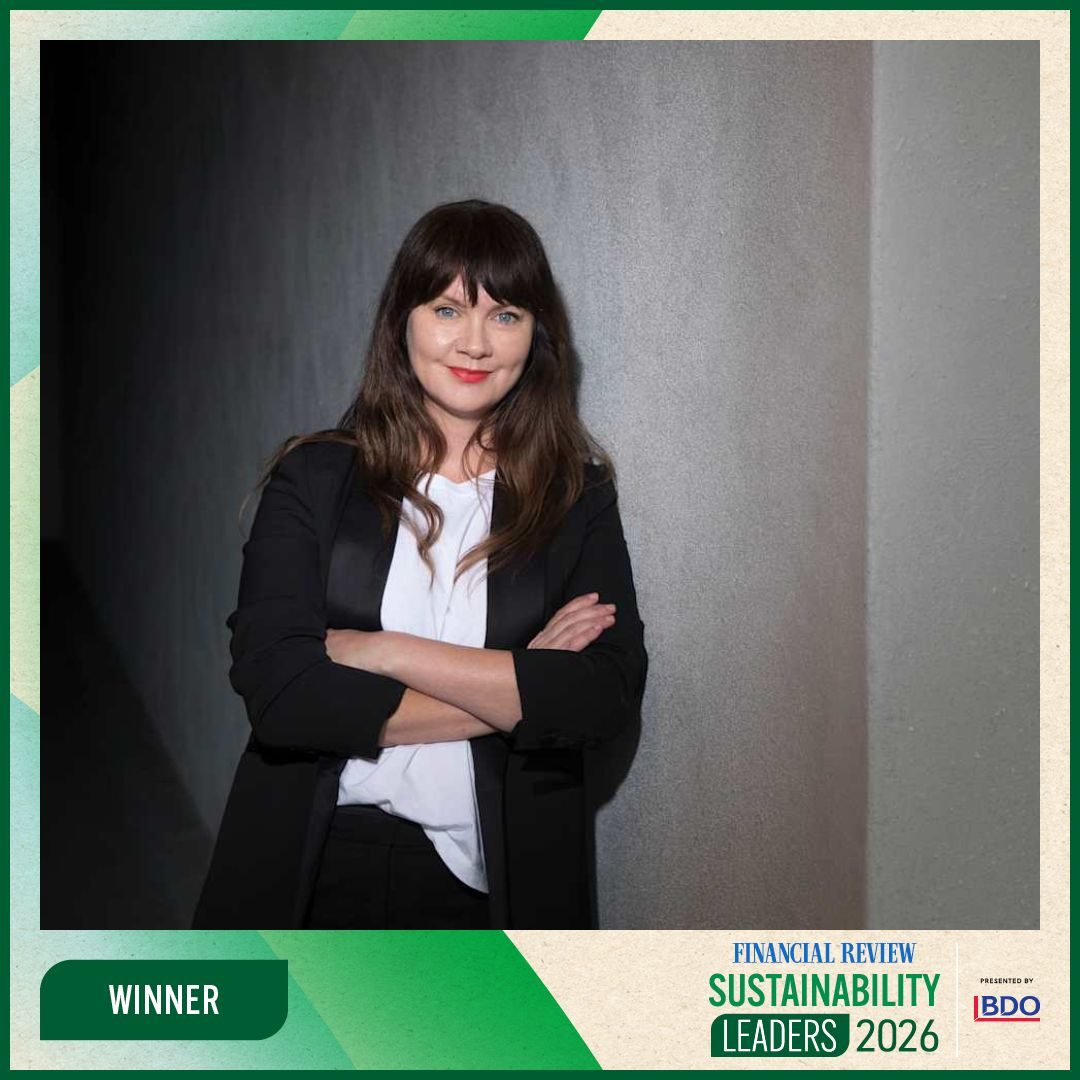
Mineral Fox has been named a Winner in the Manufacturing & Consumer Goods category of the Australian Financial Review's 2026 Sustainability Leaders, for its work transforming discarded oyster shells into high-performance architectural finishes — an innovation that is helping redefine what waste can become within the built environment.
What happens to an oyster shell after the oyster has been eaten? For most of Australia's oyster industry, the answer has traditionally been waste. For us, that question became the beginning of something much bigger.
We are so proud to have been named a Winner of the Australian Financial Review's 2026 Sustainability Leaders, recognising our work developing a circular pathway that transforms discarded oyster shells into architectural materials. The recognition marks an important milestone for us as we move from experimentation and landmark projects towards Australian manufacturing at greater scale.
From waste stream to building material
The idea sounds deceptively simple. Achieving it in practice is considerably more complex.
The idea behind the Circular Sea Collection is to take discarded oyster shells and give them another life as a building material. But oyster shells are a biological waste stream. Before they can become a consistent architectural material, challenges around collection, transport, organic matter, salt, washing, processing, grading, formulation and quality control all need to be solved.
For us, the innovation has therefore never been simply about adding crushed oyster shell to a wall finish. It is about developing the entire system required to turn an inconsistent waste stream into a material that can ultimately be specified and used within architecture.
That has required collaboration across industries — bringing together oyster producers, architects, builders, applicators, researchers, chemists, sustainability specialists, government and manufacturing partners.
It reflects one of the principles at the centre of our values: Stronger together. We believe the biggest material challenges will not be solved in isolation, but by bringing makers, designers, scientists and industry together.
600,000 oyster shells find a second life
Powerhouse Parramatta — Australia's largest cultural construction project since the Sydney Opera House.
One of the most significant demonstrations of Circular Sea to date is Powerhouse Parramatta, where more than 600,000 discarded oyster shells were transformed into material used within the building's walls.
For Founder and CEO Karmin Kenny, the project represented more than a milestone for one product. It helped change the way we think about our role in the building industry.
“We started by asking whether oyster shell waste could become something valuable again. But as we worked through the problem, we realised the opportunity was much bigger than one material. We were learning how to take a difficult waste stream and build the systems required to turn it into an architectural material at commercial scale.”
Building the next generation of materials in Australia
Scaling local manufacturing while questioning how materials are made in the first place.
From our home on Queensland's Sunshine Coast, we are building our local Australian manufacturing capability while continuing to research new approaches to material development. Our focus extends beyond what a material looks like on the wall to questions about what it is made from, where its ingredients come from, how it is manufactured and what happens throughout its lifecycle.
We are increasingly exploring the intersection between traditional mineral materials, recovered resources, regenerative inputs, contemporary materials science and advanced circular manufacturing. The goal is not simply to make conventional building materials marginally more sustainable. It is to question how they are made in the first place.
Nothing to hide
“We tell you what's in our materials, where it came from and what happens next. No vague claims. No green gloss.”
“A world where clean materials are the standard, not the premium.”
The AFR recognition arrives as we enter a significant new chapter, moving towards a material innovation company rather than simply a supplier of wall finishes. For Karmin, the recognition is less an endpoint than validation of the direction Mineral Fox is heading.
“There is still an enormous amount of work ahead of us. But recognition like this gives us confidence that the problems we're choosing to work on are worth solving. If we can demonstrate that difficult waste streams can become beautiful, high-performing and commercially viable building materials, we can start to change the conversation about where the materials around us come from — and what they could give back.”
Karmin Kenny, Founder & CEO
Circular Sea in use
A few of the projects where Circular Sea has already been specified.